
MITOCHONDRIA
Why Am I Still Exhausted After Doing Everything "Right"?
If you're following every wellness rule and still dragging through the afternoon, the answer is probably not another supplement, but a deeper question your body has been trying to ask.

Why Am I Still Exhausted After Doing Everything "Right"?
You go to bed by 10. You wake up tired.
You drink the electrolytes. You take the magnesium. You eat the protein-first breakfast, you walk in the morning sun, you cut the alcohol months ago. You traded your scrolling for journaling. You quit the late-night true-crime podcast. You even bought the red light.
And you are still dragging yourself through the afternoon like you're walking through wet sand.
If that's you, I want to gently push back on the question you've probably been asking (what am I doing wrong?) and offer a different one.
"What is my body still bracing against that I haven't named?"
Because the kind of exhaustion that doesn't respond to a perfect routine rarely comes down to willpower, and it rarely comes down to a missing supplement. Almost always, it's a signal that something deeper is still running in the background.
Let me walk you through what I see most often.
"Doing everything right" is sometimes part of the problem
I have to start here because it matters.
A lot of the women I sit with arrive having built a wellness routine so disciplined it would impress a Navy SEAL. They are tracking macros, optimizing sleep windows, scheduling their nervous-system regulation. And the routine itself has become another item on the list of things their tired body is trying to perform.
The sympathetic nervous system, your gas pedal, doesn't care whether you're sprinting from a deadline or sprinting toward perfect health. It only knows you're sprinting. And as long as it's on, the parasympathetic side (the brake: the part that actually rests, digests, repairs, ovulates, and detoxifies) can't fully come online.
So before we talk about thyroid, mitochondria, mold, or iron, I want to ask:
- Is your "wellness" being held with white knuckles?
- Is there room in your week for unstructured rest that isn't optimizing anything?
- Is the Sabbath an actual cease, or a different kind of project?
Sometimes the missing intervention is permission.
When the routine is healthy and you're still drained, look here
Once a woman has loosened the grip and the exhaustion is still there, we start walking the body backward. Persistent fatigue almost always traces back to one (or several) of these:
1. The cell danger response is still on
Your cells have a built-in defense mode. When they sense danger (infection, toxins, emotional trauma, a chronic stressor), they stop producing energy normally and start hoarding resources, throwing off inflammatory signals, and pulling up the drawbridge.
It's a brilliant short-term survival strategy that turns into a miserable long-term operating system.
The Cell Danger Response can stay switched on for years after the original trigger is gone, leaving you with bone-deep fatigue, poor exercise recovery, brain fog, and a body that can't seem to "switch back." If you've never read about it, Stuck in Survival Mode: Understanding the Cell Danger Response is the piece I send clients first.
2. Drainage is backed up
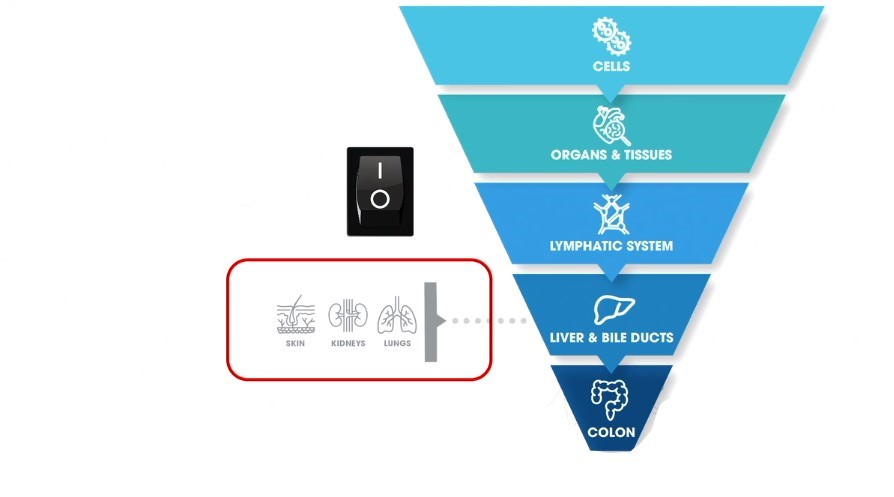
When the body's exit doors (bowels, bile, lymph, sweat, kidneys, breath) are sluggish, the byproducts of normal metabolism start to pile up. Cells are basically trying to function in a house where the trash hasn't been taken out in weeks.
You can absolutely be fatigued because you're under-clearing rather than under-fueling. Signs to look for:
- Less than one full bowel movement a day
- Pale, floating, or greasy stools (bile)
- Puffy face or fingers in the morning
- Body odor changes, or skin that breaks out near the jaw or back
- Headaches when you push detox or fast
If any of those are nodding their heads at you, The Right Way to Detox: Supporting Your Body's Drainage System is the order of operations.
3. Hidden chronic stressors
This is the bucket most "I've tried everything" stories belong in. The body cannot rest while it's defending. Common culprits I see:
- Mold in a current or past home. It can drive years of unexplained fatigue, mast cell symptoms, and brain fog. CIRS is the framework here.
- Parasites. Yes, really. More common than the medical world admits, and they steal energy by the day. See The Hidden Invaders Sabotaging Your Health.
- Gut dysbiosis or SIBO — see Why Treating SIBO Isn't Enough.
- Heavy metal load from amalgams, old water, occupational exposure.
- Past or current breast implants — see Understanding Breast Implant Illness.
- Dental infections — old root canals and low-grade abscesses are missed constantly.
You don't have to chase all of these. You only have to be willing to ask: what might my body still be defending against that I haven't acknowledged yet?
4. Under-eating disguised as "eating clean"
This one is so common I almost want to underline it twice. Women in their 30s and 40s with "perfect" diets are routinely eating 1,400–1,600 calories a day, with not enough protein and not enough carbs, and wondering why their hair is falling out and their cycles are getting weird.
If your fatigue worsens with intermittent fasting, gets worse around your period, or gets worse with exercise, you may simply be running a body on too little fuel for too long. Try, for two weeks: 100g+ of protein a day, real carbs at every meal (potatoes, fruit, rice, sourdough), and breakfast within an hour of waking.
5. Thyroid and iron: the overlooked basics
A full thyroid panel (TSH, free T3, free T4, reverse T3, TPO, TG) and a full iron panel (ferritin, iron, TIBC, transferrin saturation) are non-negotiable in a real fatigue workup. So many women have been told their thyroid is "fine" because their TSH is 3.2, which is technically in lab range and clinically nowhere near optimal. Ferritin below 50, especially below 30, will keep you tired no matter what else you do.
Low thyroid function and low ferritin usually sit downstream of the upstream issues above, and they still need real support while you do the deeper work.
6. Spiritual exhaustion masquerading as physical
I don't say this lightly, and I won't say it casually.
Some seasons of tiredness are not biochemical. They are the bill coming due on years of carrying things alone: grief, fear, a marriage that's quietly hard, motherhood without a village, the slow erosion of pretending to be fine. The body keeps that score whether or not your labs ever name it.
"Come to me, all you who are weary and burdened, and I will give you rest. Take my yoke upon you and learn from me, for I am gentle and humble in heart, and you will find rest for your souls." — Matthew 11:28–29
The rest Jesus offers is not a productivity hack. It's the laying-down of a yoke you were never asked to wear. Sometimes the most root-cause thing you can do for your fatigue is to confess to the Lord, out loud, that you have been trying to save yourself with green juice, and to ask Him to be the One who carries it.
The body softens when the soul stops bracing.
A gentler order of operations
If you want a starting point that isn't another protocol, try this for the next 30 days:
- Subtract before you add. Pull one wellness practice that has become a chore. Replace it with twenty minutes of doing nothing in the sun.
- Eat enough. Protein-anchored meals, three a day, no fasting experiments for a season.
- Open the back door. Daily bowel movements first. Hydration with minerals. Castor oil packs over the liver. Sweat 3–5x a week.
- Test the basics. Full thyroid, full iron, fasting insulin, a CBC, a CMP. If still flat, add a stool test and an organic acids test.
- Name what you've been carrying. Out loud, to the Lord, and out loud to at least one person who is safe.
You'll notice none of those steps require a new gadget or a $400 supplement stack.
A final word
If you've been doing "everything right" and you're still exhausted, you are not broken. You are not lazy. You are not failing at wellness.
You are a body the Lord made, telling you the truth.
Healing rarely comes from striving harder. More often it comes from honestly letting the body be where it is, walking back through the loop with curiosity instead of shame, and trusting the One who knit you together to be present in the slow, unglamorous rebuilding.
The exhaustion is a messenger. Let's listen to what it's saying.
Topics in this teaching

Written by
Sarah Phillipe, BSN, FDN-P, HHP
Retired RN, Functional Diagnostic Nutrition Practitioner, and Board-Certified Holistic Health Practitioner helping Christian women heal from chronic illness through faith-centered, root-cause care.
Continue reading
Related teachings

MITOCHONDRIA
Stuck in Survival Mode? Understanding the Cell Danger Response

MOLD
Understanding Chronic Inflammatory Response Syndrome (CIRS)

GUT HEALTH
Parasites: The Hidden Invaders Sabotaging Your Health
Detox
The Right Way to Detox: Supporting Your Body’s Drainage System

FAITH & HEALING