FAITH & HEALING
Christian Meditation for Anxiety: How to Calm Your Nervous System Without Emptying Your Mind
Christian meditation isn't about emptying your mind, it's about filling it with truth. A scripture-anchored, nervous-system-soothing practice for the anxious believer, with a simple 6-step framework you can start today.
Christian Meditation for Anxiety: How to Calm Your Nervous System Without Emptying Your Mind
If the word meditation makes you uneasy as a believer, you are not alone, and you are not wrong to pause.
So much of what's labeled "meditation" in the modern wellness world has its roots in Eastern spiritual practices that are genuinely incompatible with following Jesus. Emptying the mind, opening yourself to "universal consciousness," chanting mantras to unnamed energies, visualizing yourself as your own higher power; these are not neutral techniques. They are spiritual practices with spiritual fruit, and discernment is warranted.
But here is what I want you to know: Christians have been meditating for thousands of years. Long before yoga studios and meditation apps, our spiritual ancestors were practicing a deep, scripture-anchored, Spirit-led form of meditation that does not empty the mind. It fills it. And it is one of the most powerful things you can do for an anxious nervous system.
If you have struggled with anxiety—racing thoughts, tight chest, that 3 a.m. wake-up where your mind won't stop spinning—this is for you. This is a return to something the Church has always known rather than just another tool to add to your stack.
What biblical meditation actually is
The Hebrew word translated "meditate" in scripture—hāgâ—does not mean to empty. It means to murmur, to ponder, to chew on, to whisper to oneself. It is the picture of a cow chewing cud, slowly extracting nourishment from what's already been taken in. It is deeply full, not empty.
"Blessed is the one… whose delight is in the law of the Lord, and who meditates on his law day and night." — Psalm 1:1–2
"May the words of my mouth and the meditation of my heart be pleasing in your sight, O Lord, my Rock and my Redeemer." — Psalm 19:14
"I will meditate on your precepts and fix my eyes on your ways." — Psalm 119:15
Christian meditation is the prayerful direction of thought toward God, toward His word, and toward His character. It is the practice of bringing your whole self into the presence of the One who made you, and letting His truth settle deeper than the surface of your mind.
It is, in the most literal sense, the opposite of what the world is offering you.
Why this matters for your nervous system
Here is the part that makes this so beautiful: your body cannot tell the difference between a real threat and a thought about a threat. When your mind is rehearsing every worst-case scenario, your nervous system responds as if those scenarios are happening right now. Cortisol rises. Heart rate increases. Digestion slows. The breath becomes shallow. You are, in the most literal sense, marinating your tissues in stress chemistry.
This is what chronic anxiety is, a body stuck in a protective state, responding to threats that exist mostly in the imagination.
Christian meditation interrupts that cycle in a way nothing else can. When you slow your breath, anchor your attention on a single verse of scripture, and let the truth of God's character become the loudest thing in your mind, your body shifts states. The vagus nerve activates. The breath deepens. Cortisol drops. The parasympathetic system—your "rest and digest" branch—engages. You are, physically, returning to safety.
But it goes deeper than physiology. Because the anxious mind is not just dysregulated; it is believing things that aren't true. It is believing that you are alone. That you have to figure this out by yourself. That the worst is coming and there is no one strong enough to meet you in it.
Scripture meditation doesn't just calm the body. It corrects the lies.
What this looks like in practice
You don't need a special posture, an app, or thirty quiet minutes. This is a simple framework I walk my clients through when they have a verse, their breath, and ten minutes to be present:
1. Choose one short passage
Not a chapter. One verse, or even one phrase. Something that meets you where you are. A few I return to often:
- "Be still, and know that I am God." (Psalm 46:10)
- "The Lord is my shepherd; I shall not want." (Psalm 23:1)
- "Peace I leave with you; my peace I give to you." (John 14:27)
- "Cast all your anxiety on him because he cares for you." (1 Peter 5:7)
- "You will keep in perfect peace those whose minds are steadfast, because they trust in you." (Isaiah 26:3)
2. Settle your body
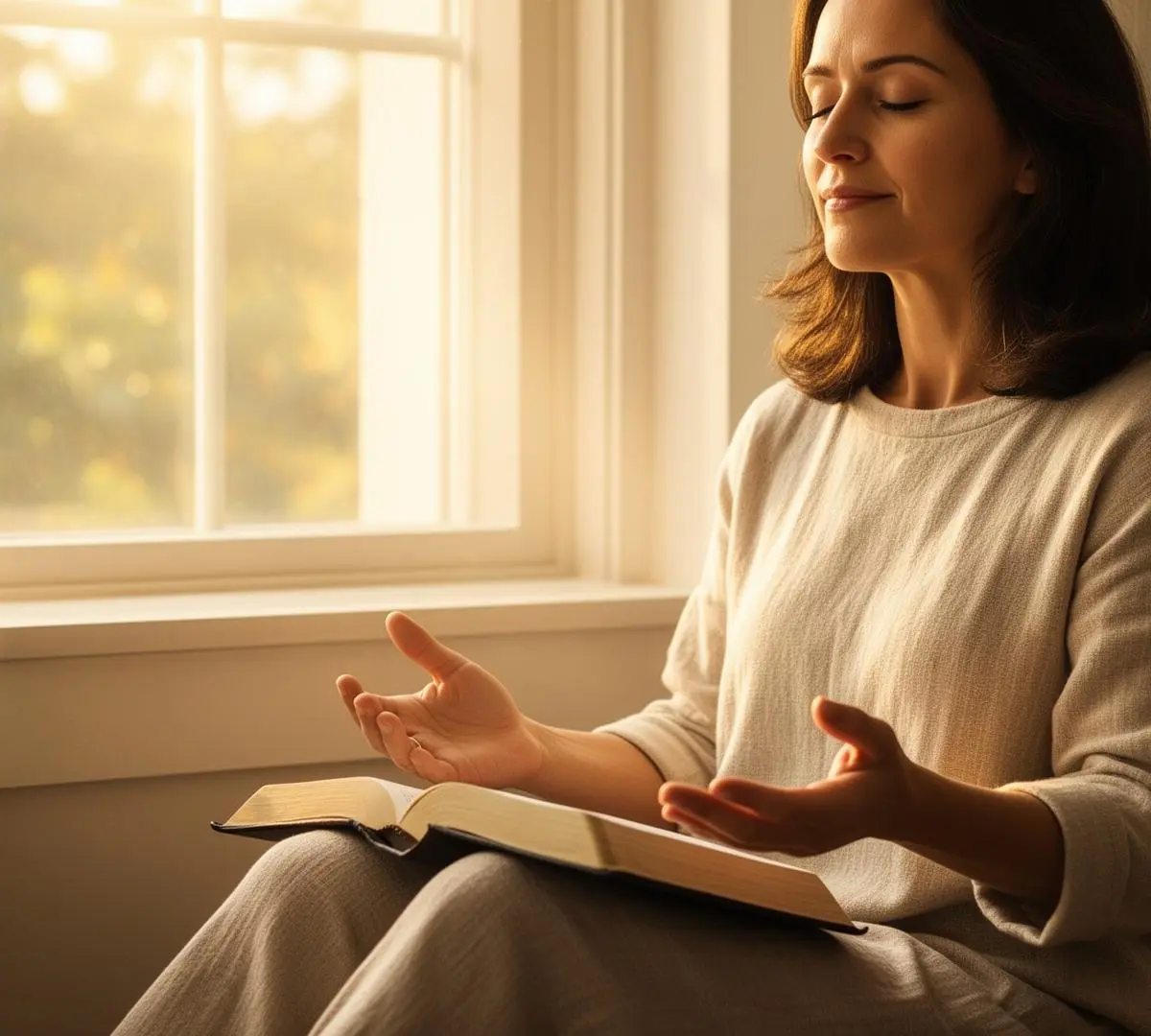
Sit somewhere comfortable. Feet on the floor. Hands open in your lap. Soften your jaw, your shoulders, and the space between your eyebrows. Take three slow breaths—in through the nose for a count of four, out through the mouth for a count of six. The longer exhale activates the vagus nerve and signals safety to your body.
3. Read the verse slowly. Out loud, if you can.
Read it once just to take it in. Read it again, more slowly. Read it a third time, emphasizing a different word each time. Be still, and know that I am God. Be still, and know that I am God. Be still, and know that I am God.
4. Linger
This is the meditation. It is a process of lingering rather than analysis. Let the words settle. Notice what stirs. Where does your body resist the words? Where does it relax? What does this truth mean for the specific thing you've been afraid of this week?
5. Pray it back
Turn the verse into a prayer. "Lord, I have not been still. I have been striving. Help me know—really know, in my body—that You are God and I am not." Be honest. He can handle it.
6. Sit in the silence
Then, for a minute or two, just be. You are not empty, but rather with Him. The way you'd sit beside someone you love without needing to speak. This is communion. This is where the deepest work happens.
A note for the woman whose anxiety feels bigger than this
If you are reading this and thinking that's lovely, but my anxiety doesn't respond to a verse and some deep breaths, I hear you. And I want to be honest with you.
Chronic anxiety is rarely just a thought pattern. Often it sits on top of real, physiological dysregulation: depleted minerals, blood sugar swings, an inflamed gut, mold or other biotoxin exposure, hormonal imbalance, and unresolved trauma in the body. Meditation is powerful, but it is not a substitute for addressing the soil.
If your anxiety has been there for years, if it spikes at the same time every day, or if it comes with physical symptoms that don't quit, there is more going on. The most loving thing you can do is investigate. Christian meditation belongs alongside root-cause healing, not instead of it.
But even in the middle of the deeper work, this practice changes things. It is not the whole answer. It is, quietly, one of the most important parts of the answer.
What it does over time
The first time you sit with a verse and your breath, it may not feel like much. The second time, slightly more. By the second week, something starts to shift. You begin to notice that the racing thoughts have less grip on you. That you can return to "Be still, and know" in the middle of a hard moment without having to close your eyes or sit down. That the truth has started living in your body, not just your head.
This is what scripture promises. This is the renewing of the mind that comes by dwelling, with intention, in what is true until what is true becomes the soundtrack underneath your life.
Your nervous system was designed by God. Your anxiety is real, and your body is wise, and the same Spirit who hovered over the waters at the beginning is hovering over your life right now. He is not asking you to figure out how to calm yourself. He is asking you to come and be with Him.
"Come to me, all you who are weary and burdened, and I will give you rest." — Matthew 11:28
Start with one verse. Start tomorrow. Start today.
You don't have to empty your mind. You just have to fill it with Him.
Topics in this teaching

Written by
Sarah Phillipe, BSN, FDN-P, HHP
Retired RN, Functional Diagnostic Nutrition Practitioner, and Board-Certified Holistic Health Practitioner helping Christian women heal from chronic illness through faith-centered, root-cause care.