
HORMONES
Is It My Hormones or Is It My Gut? How to Tell What's Actually Driving Your Symptoms
You don't have to choose between a hormone problem and a gut problem because they're the same loop. Here's how to read your symptoms, find the upstream driver, and stop bouncing between protocols.

Is It My Hormones or Is It My Gut? How to Tell What's Actually Driving Your Symptoms
You've been doing the work.
You cleaned up your diet. You're tracking your cycle. You ordered the at-home cortisol test, maybe even the DUTCH. You've cut the seed oils, added the protein, and stopped scrolling in bed. And still, you're dealing with the bloating, the mood swings, the 3 a.m. wake-ups, the period that feels heavier and crampier than it used to, and the brain fog that rolls in by 2 p.m. like clockwork.
So you start asking the question almost every woman I work with eventually asks:
"Is this a hormone problem? Or is this a gut problem?"
It's a fair question, though it misses the bigger picture.
In the body, those two systems aren't on separate tracks. They're on the same conveyor belt, and pulling on one end always tugs the other. The real question isn't which one is broken. It's where in the loop did things start to break down, and what is your body actually asking you to listen to?
Let's walk through it together.
Why "hormones vs. gut" is a false binary
When we talk about hormones, most of us mean the sex hormones—estrogen, progesterone, testosterone—and maybe cortisol and thyroid if we've been doing this for a minute. We picture them as something the ovaries and the adrenals "make," like a factory turning out finished product.
But hormones aren't just made. They're also metabolized, transported, and cleared; that entire second half of the conversation happens in the liver and the gut.
Here's what that looks like in plain terms:
- Your liver takes used-up estrogen and tags it for removal—a process called methylation and conjugation.
- That tagged estrogen gets dumped into bile and sent into the intestines.
- A healthy gut escorts it the rest of the way out through the stool.
- An unhealthy gut—one with dysbiosis, constipation, or an enzyme called beta-glucuronidase being overproduced by the wrong bacteria—actually un-tags that estrogen and sends it back into circulation.
Translation: you can have perfectly fine ovaries and still end up with estrogen-dominant symptoms because your gut is recycling hormones your body was trying to get rid of.
This is why hormone replacement, seed cycling, and even bioidentical progesterone so often plateau. We're treating the output of a loop without addressing the loop itself. If you want to go deeper on that mechanism, the piece on estrogen dominance and its root causes walks through the bile, liver, and microbiome pieces in more detail.
What the body is actually telling you
The pattern of your symptoms is usually a louder clue than any one lab result. Not because labs lie, they don't, but because labs measure one moment, and your body has been telling a story for years.
A few patterns I see over and over:
It's probably leaning gut-driven if:
- Bloating is one of your loudest symptoms, especially after meals
- You feel worse, not better, on a "clean" high-fiber diet (fermentable foods like garlic, onions, beans, avocado)
- You're constipated (fewer than one full bowel movement a day, or stools that are dry, pellet-y, or hard to pass)
- Your skin breaks out in cycles, but you also notice itchy ears, post-meal fatigue, or food sensitivities that keep multiplying
- You've had food poisoning, frequent antibiotics, a season of high stress, or a hormonal birth control history that you've never really "rebounded" from
- Your symptoms shift dramatically depending on what you ate that week
It's probably leaning hormone-driven if:
- Symptoms track tightly to your cycle; a week before your period feels like a different person than ovulation week
- You're in perimenopause (mid-30s to early 50s) and the floor is shifting under your feet—sleep, mood, joints, libido, body composition all changing at once
- Heavy or painful periods, clotting, breast tenderness, or new PMS that wasn't there a few years ago
- Hair thinning, irregular cycles, acne along the jawline, or facial hair changes
- You feel "tired but wired" (exhausted but unable to sleep, anxious mornings, crashing afternoons)
But here's the catch: most women I work with have both columns highlighted. And the reason is that the systems are speaking to each other constantly. A gut that isn't clearing estrogen creates hormonal symptoms. A nervous system stuck in fight-or-flight creates gut symptoms. Inflammation in one place becomes inflammation in another.
So instead of trying to declare a winner, look for the upstream thread.
The 5 upstream drivers underneath both
When you stop chasing the symptom and walk back through the body, almost every "is it hormones or gut" question lands in one (usually more) of these five places:
-
Chronic stress and a dysregulated nervous system. Your body cannot prioritize digestion and reproduction and detox while it's bracing for danger. Cortisol gets pulled from the same raw materials as progesterone. When cortisol demand goes up, progesterone often goes down. (More on this in Stuck in Survival Mode: The Cell Danger Response.)
-
Gut dysbiosis, SIBO, or parasites. Imbalanced bugs change how you make neurotransmitters, how you absorb minerals, how you tolerate fiber, and how you clear hormones. A bandaid like a low-FODMAP diet can quiet symptoms while the underlying ecosystem keeps drifting in the wrong direction—see The SIBO Diet: why it helps and why it's not the cure.
-
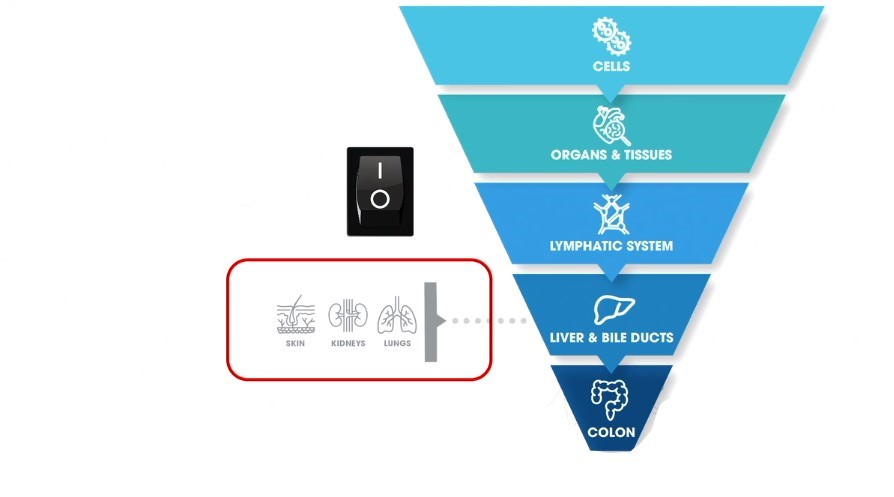
Sluggish drainage and detox. If your liver, bile, lymph, and bowels aren't moving, hormones can't leave the building. This is where so many women add supplements for their hormones and feel worse, because they're pushing detox into a body whose doors are stuck. The right way to detox is about opening doors first, not pushing harder.
-
Blood sugar swings. Sharp glucose spikes and crashes drag cortisol up, drop progesterone, drive cravings, and disrupt sleep, which then disrupts hormones further. You don't need a continuous glucose monitor to fix this. You need protein and fat at every meal, especially breakfast.
-
Hidden inflammation. The body deprioritizes hormone production and gut repair when it thinks it's under attack. This often involves mold, breast implants, dental infections, long-haul viral activity, and chronic low-grade infections. Chronic Inflammatory Response Syndrome is one example of how this looks in real women.
Notice something? None of those starting points are "your ovaries are broken" or "your gut is broken." They're terrains. They are conditions of the environment your hormones and your gut are trying to function inside.
The question that actually moves the needle
So instead of "is it my hormones or my gut," try sitting with this one:
"What has my body been carrying that I haven't acknowledged yet?"
I know that sounds less clinical than a lab panel. But it's often more honest. Because the women who heal don't get there by stacking more protocols on top of an exhausted nervous system. They get there by going quiet enough to hear what their body has been trying to say and then patient enough to address the upstream root, even when the downstream symptom is the thing screaming the loudest.
Sometimes that root is biochemical, such as a parasite, mold exposure, or bile that won't flow. Sometimes it's structural: years of under-eating, oral contraceptives starting at 15, or four pregnancies in five years. Often it's spiritual: a low hum of fear that your body has betrayed you, or a striving that never lets the parasympathetic nervous system actually come online.
All of it counts. All of it is information. None of it is a verdict on you.
A gentle place to start
If you don't know which way to pull the thread first, here is the order I almost always recommend with my own clients:
- Nervous system first. Before any new supplement, before any new test. Two weeks of consistent meals, morning sunlight, slower mornings, real Sabbath, and prayer in the quiet. You will be shocked what stabilizes.
- Drainage second. Daily bowel movements, hydration with minerals, gentle bile support, sweat, movement. Open the doors.
- Terrain testing third. Then—when the body is regulated and the doors are open—look at a comprehensive stool test, an organic acids test, and a DUTCH together. They'll tell a much more coherent story.
- Hormone support last. Targeted, brief, and almost always alongside continued root work (not as a replacement for it).
That order alone has resolved more "I think I need HRT" conversations than any prescription pad ever could.
A word for the woman who is tired of asking
If you've been bouncing between providers, between protocols, between "is it my hormones or is it my gut" for years, I want you to hear something:
The framework was the problem, not you.
Your body is not a stack of disconnected systems waiting to be optimized. It's a whole, integrated, intelligent house that the Lord knit together; it's allowed to fall apart sometimes, and it's allowed to take a long time to rebuild. You do not have to figure this out in a single article, a single appointment, or a single season.
"He heals the brokenhearted and binds up their wounds." — Psalm 147:3
Healing is a returning rather than a transaction. Bring all of you—the gut and the hormones and the grief and the hope—and trust that the One who designed the whole loop knows exactly where to start.
I'd start there too.
Topics in this teaching

Written by
Sarah Phillipe, BSN, FDN-P, HHP
Retired RN, Functional Diagnostic Nutrition Practitioner, and Board-Certified Holistic Health Practitioner helping Christian women heal from chronic illness through faith-centered, root-cause care.
Continue reading
Related teachings
HORMONES
Estrogen Dominance: The Root Causes No One Is Telling You About

GUT HEALTH
The SIBO Diet: Why It Helps (and Why It's Not the Cure)

MITOCHONDRIA
Stuck in Survival Mode? Understanding the Cell Danger Response
Detox
The Right Way to Detox: Supporting Your Body’s Drainage System

Root Cause