
Detox
Your Home Is Part of Your Healing: A Practical Guide to Environmental Toxins
Water, cookware, skincare, plastics, and cleaning products are the everyday exposures quietly overloading your body, and a sane, faithful way to steward your home one small choice at a time.
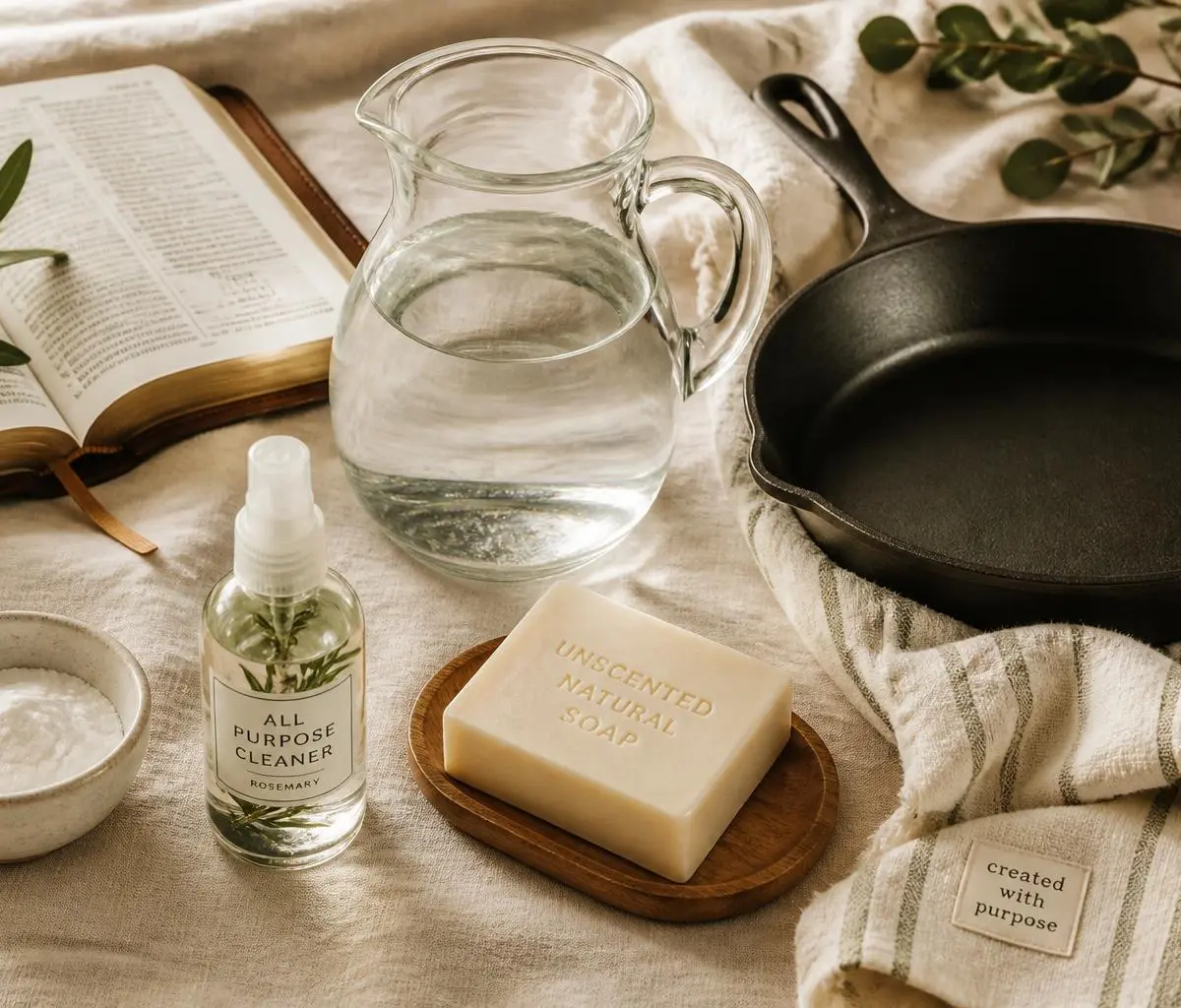
Your Home Is Part of Your Healing: A Practical Guide to Environmental Toxins
If you've been doing all the right things, like eating clean, taking the supplements, working on your gut, and regulating your nervous system, and your body still feels like it's pushing uphill, this conversation is for you. Because there is one variable most healing plans quietly ignore: the home you're healing inside of. The water you drink. The pan you cook in. The lotion you rub into your skin twice a day. The candle you light to feel cozy. The plastic container that holds your leftovers. None of these things are loud. Most of them feel normal, even healthy. But added together, they form the daily exposure load your body has to keep up with, and for many women, it's the silent reason healing keeps stalling.
This is a matter of stewardship rather than fear. Your body is a temple of the Holy Spirit (1 Corinthians 6:19), and the home you build around it matters. Small, faithful choices over time genuinely change what your liver, kidneys, lymph, and cells have to process, which is far better than chasing a perfect, plastic-free, organic existence. That pressure is its own kind of toxic. This is the layer most root-cause work skips. Let's slow down and walk through it together.
Why Everyday Exposures Matter More Than You Think
Modern bodies are not dealing with one big toxin. They're dealing with thousands of small ones every day for decades. The Environmental Working Group has identified over 80,000 chemicals registered for use in the United States, and the vast majority have never been tested for long-term human safety, let alone for how they interact with each other. Your body wasn't designed to filter that. It was designed to handle the occasional smoke from a cooking fire, not a lifetime of fragrance chemicals, plasticizers, pesticide residues, flame retardants, and heavy metals leaching in from every corner of ordinary life.
Here's what that constant low-grade exposure actually does. It overloads your liver's detox pathways, so the things your liver should be clearing (used hormones, metabolic waste, environmental toxins) start backing up. It disrupts your endocrine system, which is why so many women in their thirties and forties are dealing with thyroid issues, estrogen dominance, irregular cycles, and stubborn weight that won't move no matter what they eat. It inflames your gut lining, contributing to leaky gut and food sensitivities. It depletes minerals your mitochondria need to make energy. And it confuses your immune system, which can be one of the upstream triggers for autoimmunity.
You don't feel any single exposure. You feel the sum of all of them as fatigue, brain fog, anxiety, hormonal chaos, skin issues, headaches you can't trace, and a body that just feels harder to live in than it should.
The Bucket Analogy
I teach my clients to picture their body's detox capacity like a bucket. Every exposure — the chlorinated shower water, the synthetic fragrance in your candle, the nonstick pan, the plastic water bottle warming in your car — adds a drop. Your liver, kidneys, lymph, and gut are the drainage holes at the bottom. As long as drops in and drops out stay roughly equal, you feel fine. But when daily exposures outpace your drainage, the bucket overflows. The overflow is your symptoms.
Most women try to heal by working harder on the drainage side with more supplements, more saunas, and more protocols. That helps. But if the bucket keeps filling at the same rate, you're treading water. The faster path to relief is almost always reducing what's going in. That's what stewarding your home actually means.
Water: The First Place to Look
You drink it, cook with it, shower in it, and your skin absorbs it. Water is the single largest daily input into your body, which makes it the single biggest lever for change. Most municipal tap water in the United States contains chlorine or chloramine, fluoride, trace pharmaceuticals that wastewater treatment can't fully remove, heavy metals like lead from aging pipes, and a growing list of forever chemicals known as PFAS. The EPA's own data shows PFAS contamination in the drinking water of more than 200 million Americans. These chemicals don't break down in your body; they accumulate.
What I recommend isn't extreme. Start with a quality drinking water filter — a countertop or under-sink system that addresses chlorine, fluoride, heavy metals, and PFAS. Brands like Berkey, Clearly Filtered, and AquaTru are well-tested options. Next, add a shower filter. Hot water opens your pores and turns chlorine into vapor you inhale; a $50 shower filter genuinely changes the load. If you can eventually add a whole-home filter, that's the gold standard, but it's not where to start.
And please, stop drinking from plastic water bottles that have been sitting in a warm car. Heat accelerates plastic leaching, and the BPA, BPS, and phthalates that come out of that bottle are some of the most well-documented endocrine disruptors we have. Glass or stainless steel. Always.
Cookware: What's Touching Your Food
The pan you cook in matters because heat is what mobilizes whatever your cookware is made of. Nonstick coatings (the slick Teflon-style finishes) release perfluorinated compounds when heated, especially above 500°F. These are the same PFAS chemicals contaminating water supplies, and they're linked to thyroid disruption, immune dysfunction, and certain cancers. Aluminum cookware leaches aluminum, which has been increasingly studied for its role in neurological inflammation. Even some ceramic-coated pans use coatings that degrade quickly.
The safer choices are simple and they last forever. Cast iron, properly seasoned, gives you an indestructible cooking surface and a small mineral boost of iron. Stainless steel (look for 18/10 grade) is non-reactive and durable. Glass and enameled cast iron — like Le Creuset or Lodge — are excellent for baking, roasting, and slow cooking. You don't need a whole new kitchen. Start with the pan you use most, and replace cookware as the budget allows.
Skincare and Personal Care: The Body's Largest Organ
Your skin is permeable, not just a barrier as we used to think. Lipid-soluble compounds in lotions, deodorants, sunscreens, makeup, and hair products absorb through the skin and enter circulation, bypassing your liver's first-pass detox entirely. The average woman applies around 168 chemicals to her body every morning before she leaves the house, and many of them carry warnings the FDA never required to be tested.
The biggest offenders to learn to spot on labels: parabens (preservatives that mimic estrogen), phthalates (often hidden inside the word "fragrance"), sodium lauryl/laureth sulfate (skin disruptors), formaldehyde and formaldehyde-releasers, oxybenzone and avobenzone in conventional sunscreens, and synthetic fragrance — which is a legal loophole that can hide hundreds of undisclosed chemicals under one word on the label.
What to do instead: simplify before you swap. Most women use far more products than their skin actually needs, and "clean" versions of unnecessary products aren't an upgrade. Then start replacing your high-use items first — the deodorant, the body lotion, the face moisturizer, the shampoo and conditioner. Use the EWG Skin Deep database (ewg.org/skindeep) to vet products in seconds. Brands like Branch Basics, Beautycounter, Primally Pure, Crunchi, and Annmarie Skin Care are solid starting points. For sunscreen, look for mineral-based formulas with zinc oxide as the active ingredient.
And here's a permission slip: you don't have to throw everything out today. Use what you have, and when something runs out, replace it with a cleaner version. Stewardship is sustainable. Panic is not.
Plastics: The Quiet Hormone Disruptor
Plastic is everywhere, and almost all of it is hormonally active. BPA was the first plasticizer to get headlines, and many products are now labeled "BPA-free," but the replacements (BPS, BPF, and others) are often just as endocrine-disrupting. Phthalates make plastics flexible and are in everything from food packaging to children's toys to vinyl shower curtains. Microplastics — particles small enough to cross the gut lining and even the blood-brain barrier — are now being found in human blood, lung tissue, placentas, and breast milk.
You will not eliminate plastic. Don't try. But you can reduce the highest-contact exposures: never microwave food in plastic, never store hot food in plastic, swap plastic food storage containers for glass (Pyrex with glass or silicone lids is inexpensive and forever), avoid plastic-lined canned goods, and choose a vinyl-free shower curtain. Replace plastic cutting boards with wood or bamboo as they wear out. These are small choices that compound.
Cleaning and Laundry: The Air You Breathe All Day
Conventional cleaning products and laundry detergents are some of the most concentrated sources of indoor air pollution. Indoor air, according to the EPA, is often two to five times more polluted than outdoor air. Fragranced laundry products in particular release a class of chemicals called VOCs (volatile organic compounds) every time you do a load. You inhale them. Your skin absorbs them from your clothes and sheets all night long. Dryer sheets coat your fabrics — and your nervous system — in synthetic fragrance and quaternary ammonium compounds for days.
Switching here is one of the highest-impact, lowest-effort moves you can make. White vinegar, baking soda, castile soap, and a few essential oils handle 90% of cleaning needs in most homes. For laundry, fragrance-free detergents from Branch Basics, Molly's Suds, or Truly Free work beautifully. Skip dryer sheets entirely; wool dryer balls do the same job. Open your windows daily, even in winter, even for ten minutes. Air movement matters.
Where to Start (Without Burning Out)
Reading a list like this can feel overwhelming, and overwhelm is its own form of toxic load on the nervous system. So let me give you a sane, sequenced way to begin — the same one I walk my clients through.
In the first month, focus on what's going into your body most directly: filter your drinking water, get a shower filter, and stop microwaving or storing hot food in plastic. In the second month, work on what touches your skin every day — swap your deodorant, body lotion, and shampoo for cleaner versions as the bottles run out. In the third month, tackle your cleaning and laundry products and replace your highest-use nonstick pan. By month four, you've meaningfully reduced your daily exposure load without spending a fortune, without throwing out a working kitchen, and without making your home a source of stress instead of rest.
This is what stewardship looks like in real life. Slow. Faithful. Imperfect. Sustainable.
The Spiritual Layer Most People Skip
Here's the part of this work that doesn't get talked about enough: cleaning up your environment is a form of worship. The Bible calls our bodies temples. A temple is not a place you neglect or abuse; it's a place you tend with reverence, because Someone you love lives there. When you filter your water, when you choose the safer pan, when you replace the synthetic candle with beeswax, you are not being legalistic. You are being a steward of the dwelling place God gave you. And He honors that.
Jesus invites us into more freedom as we steward our homes, recognizing that while our choices matter, our standing with Him is not earned by perfect organic living. He sees the heart. He sees the effort. And He gently invites us, over time, into more freedom — including freedom from the things that quietly inflame, disrupt, and burden the body He's asking us to live in for the long haul.
So take a breath. Pick one thing. Start there. The bucket gets lighter one drop at a time — and your body will tell you, in clearer skin, better sleep, calmer moods, and steadier energy, that the small choices were never small at all.
Topics in this teaching

Written by
Sarah Phillipe, BSN, FDN-P, HHP
Retired RN, Functional Diagnostic Nutrition Practitioner, and Board-Certified Holistic Health Practitioner helping Christian women heal from chronic illness through faith-centered, root-cause care.
Continue reading
Related teachings

FAITH & HEALING
What Is Christian Functional Medicine? A Faith-Centered Guide to Root-Cause Healing

GUT HEALTH
The Truth About Parasite Cleanses: Why Kill-Protocols Without Terrain Work Often Backfire and What to Do Instead

AUTOIMMUNITY
Your Body Is Not Attacking You: The Upstream Story Behind Autoimmunity

Root Cause